
Grand County Projected vs Actual
A projected release date is an estimate or scheduled date before release happens. An actual release date is the date custody changed. In Grand County, that difference is important because many jail releases are not sentence calculations. They are bond releases, court-ordered releases, time-served releases, or transfers to another agency. The Grand County Detentions page gives bond instructions and tells callers to contact the jail for bond type and amount. It does not publish a local sentence calculator or a public projected-date feed.
For state prisoners, projected or tentative release is a CDOC sentence-administration concept. It may involve sentence length, presentence confinement credit, parole eligibility, earned time, offense category, disciplinary issues, and later court orders. A projected date can move. Treat it as a status field to verify close to the date, not as a guarantee.
Find a Grand County Release Date
Start with the source that controls the person now. County jail staff can confirm current custody, bond status, and local release questions. The court record can show bond orders, sentencing, probation, revocation, dismissal, or sentence credit events. CDOC is the correct source only when the person has been sentenced to Colorado state prison or is under CDOC supervision.
- Call the Grand County jail at 970-725-3343 for current county custody, bond, or local sentence questions.
- Check the Colorado Judicial Branch docket for the court event that may set or change release.
- Use the CDOC offender search when the person was sentenced to state prison.
- Search by DOCNO when known, or by name and gender when the DOC number is not known.
- Read CDOC status and date fields cautiously, because public labels and available fields can vary by offender status.
- Use Colorado VINE for release or transfer alerts while the person remains in the VINE data feed.
The CDOC page is also linked from Colorado's locate an inmate service page. If CDOC does not answer a state-prison date question, use the court sentence record and a CDOC records channel rather than asking the county jail to certify a state discharge.
Colorado Earned Time Rules
Colorado parole eligibility and earned-time law are category-specific. C.R.S. 17-22.5-403 governs parole eligibility. In general terms, many felony sentences have parole eligibility after a statutory portion of the sentence is served, with earned time applied where authorized, but the statute includes many exceptions. The rule depends on offense, offense date, sentence structure, and statutory category.
C.R.S. 17-22.5-405 governs earned time. Earned time is not a simple calendar shortcut. It can depend on statutory authority, CDOC administration, program progress, disciplinary record, offense class, and later changes. Colorado also has stricter rules for some violent offenses, including current-law changes after Proposition 128 for certain offenses committed after its effective date. Do not reduce Colorado release dates to one statewide percentage.
The manifest includes a section-level capture of the earned-time statute used for this page. That law helps explain why two people sentenced from Grand County can have different CDOC projected dates despite similar sentence lengths.
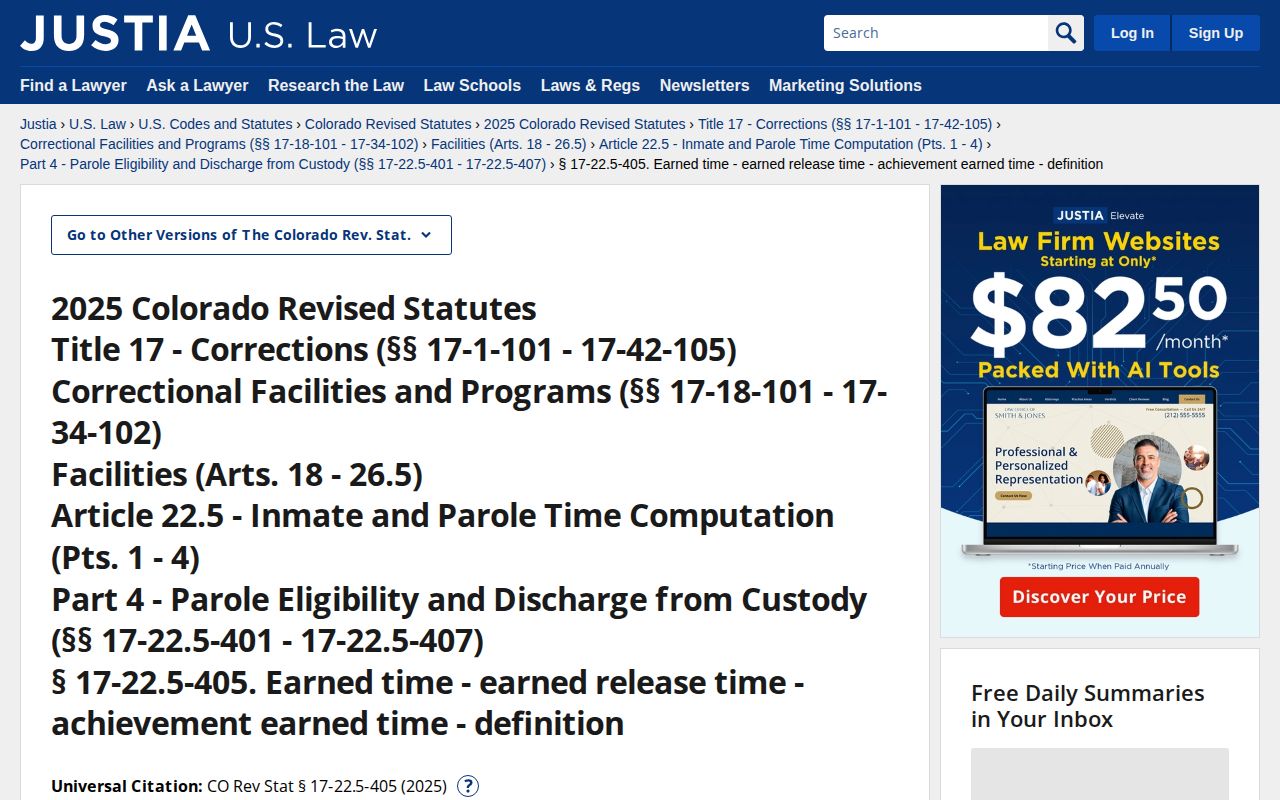
Use the statute as background, then confirm the actual person through CDOC, the court record, or the jail depending on custody type.
Why Grand County Dates Change
Projected dates move because release is a legal and administrative result, not a static calendar entry. A county bond release can change after a court modifies bond. A local sentence can change after the court corrects credit. A CDOC projected date can change after intake, credit review, earned-time decisions, parole-board action, or a later court order.
| Factor | How it can affect release |
|---|---|
| Remote bond | Grand County posts a six-hour remote-bond release right when that HB25-1015 rule applies. |
| Presentence confinement credit | Credit can change the remaining time on a local or state sentence. |
| Earned time | CDOC may apply, withhold, restore, or adjust earned time under Colorado law. |
| Parole-board action | A hearing can grant, deny, defer, rescind, or otherwise affect state-prison release timing. |
| Detainers and holds | A person may leave one custody lane but be held or transferred for another agency. |
| Court orders | Bond orders, amended mittimus, appeals, revocations, and corrections can change the controlling date. |
Grand County's local bond page adds one timing point that is more concrete than most projected-date guesses. The county posts remote-bond rights under HB25-1015 and states that defendants must be released within six hours of a remotely posted bond when that rule applies. That timing belongs to eligible remote bond transactions. It is not a CDOC release calculation, not a weekend-release policy, and not a rule for transfers or sentenced jail terms. The safest use is narrow: call the jail before payment, follow the remote payment instructions, then call again if the posted bond does not produce a release within the stated window.
Grand County Court Date Trail
The court record is often the best way to understand why a projected date exists or why no date exists. A bond order, sentence, probation term, amended mittimus, revocation, dismissal, or time-served order can all explain the jail status. Grand County's Judicial Center is the local court contact, and the Colorado docket search requires at least one filter in addition to date. CoCourts can provide a Register of Action, which is useful for event history, but it is not the full case file and not the official court record.
Use the court trail when the jail can say the person is not in custody but cannot provide the legal reason in the detail needed. A court event may show that bond was modified, that probation was imposed, that a sentence was completed, or that the person was remanded for another reason. If the online court data seems incomplete or wrong, the Colorado Judicial access guide points users back to the court where the original record was created and filed.
Grand County Transfer Dates
A transfer date is not always a release date in the everyday sense. If the Grand County jail releases a person to CDOC, another county, federal custody, or immigration custody, the local record may show that Grand County custody ended while another system began. That is why a person can be "released" from the county facility but still not be free from custody. The next date may come from CDOC, BOP, ICE, the U.S. Marshals, or a receiving jail.
For state transfers, CDOC performs the state time computation after sentence intake. The county court sentence and jail transfer record help identify the handoff, but CDOC becomes the source for prison status, parole eligibility, release, and discharge fields. For federal or immigration transfers, Grand County records may document the local release to another agency, while BOP, U.S. Marshals, or ICE channels explain the next custody stage.
Confirm Grand County Release Dates
Use a confirmation chain close to the expected date. For a county jail bond release, call the jail before and after payment and check the court event. For a local sentence, ask the jail and compare the sentence in the court record. For a CDOC sentence, search CDOC and use the parole-board entry when parole timing is relevant. For notification, the VINELink release check can send an alert when the person is in the VINE feed and a custody change is reported.
A release alert is not the same as a certified record. For a copy, request the Grand County jail release record, court disposition, or CDOC record from the custodian. If the person moved to federal or immigration custody, use BOP, U.S. Marshals, or ICE channels because Grand County's release record may only show a transfer.
Question: Can a Grand County jail release date be found in CDOC? Only if the person entered CDOC or CDOC supervision. A bond release or short county jail stay may have no CDOC record at all.
Public Record Search
Sponsored Results